
• Skip to primary navigation
  • Skip to main content
  • Skip to primary sidebar
  • Skip to footer
  • Advertise
  • Subscribe

Hose Assembly Tips

Fluid Power Resources for Hose and Hose Assemblies

  • Hose Assembly Blog
  • Industry News
  • Hydraulic hose
    • Rubber
    • Thermoplastic
  • Pneumatic tubing
  • Fittings
    • Hydraulic
    • Pneumatic
  • Couplings
    • Hydraulic
    • Pneumatic
    • Quick-acting
  • Design Guides

How long should a hose last (and tips to extend service life)

November 2, 2023 By Mary Gannon Leave a Comment

By Josh Cosford,  Contributing Editor

How long a hydraulic hose should last depends on many factors, not the least of which is who you ask. Some standards want to see hoses changed every few years, yet others are okay up to ten years (such as with the SAE). But do we even need to apply a death clock to hydraulic hoses if they’re properly cared for? The short answer is yes, but that doesn’t mean we must prematurely swap hoses based on counting full moons. Let’s dig into the factors that affect hydraulic hose life.

Applications vary from cleanroom power units for testing NASA rockets to logging equipment trudging through cold mud, so to require the same hose maintenance schedule might not be prudent. You can combine industry recommendations with applicational and historical considerations.
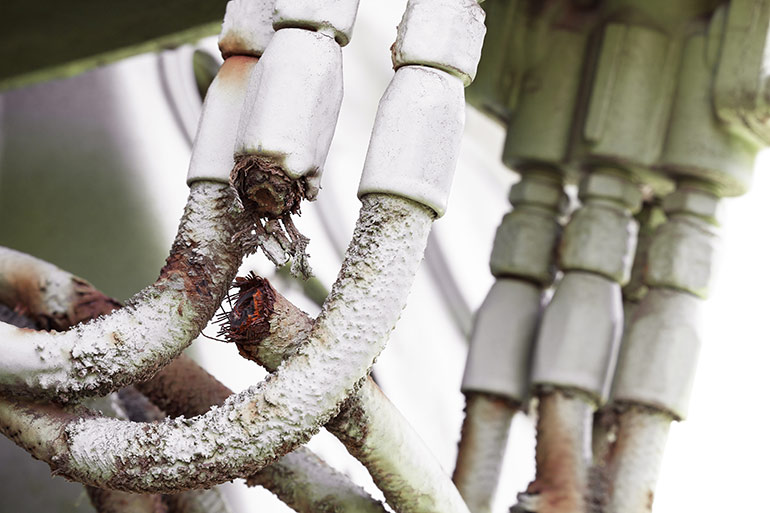
This hydraulic hose has certainly exceeded its life. Knowing hose long hydraulic hose lasts, as well as factors that contribute to its demise, is critical to uptime. Image courtesy of AdobeStock

Let’s start by saying you should probably change your hydraulic hoses within ten years max. Even a hydraulic hose sitting unused in your warehouse should be scrapped after ten years, as even general ambient deterioration factors such as sunlight, moisture and ozone will degrade the hose over time.

When you factor in large temperature swings, such as with arctic machinery resting overnight in frigid climates and then firing up the next morning for a day of operation, the expansion and contraction of the rubber accelerates aging. In such circumstances, a hose may swing across a hundred degrees of variability, fatiguing the structure of the inner tube and cover.

Combining pressure fluctuations or spikes within a deteriorating hose also reduces its lifespan. Imagine your already-weakened hose being subjected to pressure spikes as the machine operator slams his excavator’s hydraulic hammer into the side of a building he’s demolishing, for example. Conversely, an industrial conveyor using a hydraulic motor drive seeing relatively constant ambient conditions while subjected to fewer of the pressure spikes of mobile machine will result in highly reliable hoses.

You can predict hose service life by factoring in specific machine and operation conditions. I’m never a fan of arbitrarily changing hydraulic parts that don’t need it, but unless you have your own crimper and stock of hose and fittings to create new hoses on the fly, it’s likely a failure will result in downtime. Replacing a thousand dollars in hoses every three years on your production-critical machines is nothing compared to the thousands of dollars per hour you lose when your machine goes down. And try telling your customers you can’t deliver their order because your local hose shop has to bring in the 6-wire hose on your injection molding machine.

It’s always a good idea to track your maintenance activities, even from unexpected downtime. You need to understand how your own application and ambient environment affect the life of your hoses. Manufacturers and standardization bodies can’t know what you know, which is why they can only offer guidelines. Knowing that your machine always seems to blow a pressure line every few years helps you stay on top of preventive maintenance, which avoids costly downtime.

Regardless of your machine or environment, you can put measures in place to increase the useful life of your hydraulic hoses. For one, only operate your machine within its design specifications. If your machine was designed to run at 2,500 psi, don’t push things to 3,000 psi just because you want more force. The hoses selected may be rated for only 2,500 psi, and pushing higher will reduce reliability.

Additionally, using hose wrap not only protects from abrasion but the sleeve style also reduces exposure to ambient chemicals, industrial fallout or road film. And while protecting the outside of your hose, you should consider the health of its inside. Keeping your oil cool and dry will prevent oxidation, hardening and cracking of the inner tube. By cool, of course, I mean within the normal operating limits of hydraulic machinery (think 120°F [50°C], give or take). And you’d be surprised at the amount of water hydraulic oil can hold in solution without the obvious appearance of free water. Most NBR hoses are okay with water, but your hydraulic oil isn’t. It can oxidize and sludge, which could result in the degrading of the nitrile tube.

If machine uptime is the most critical factor in deciding whether to change your hoses every five years, by all means, change them. Some factories, such as Tier 1 automotive suppliers, run at capacity with just-in-time production that prioritizes uptime. You know your machine, and you know your production requirements, so use the preceding information to schedule a hose changeout program that works for you. And lastly, if your hose looks like it requires changing; absolutely change it!

 

Filed Under: Featured, Hose Assembly Blog, Hydraulic hose, Rubber

Reader Interactions

Leave a Reply Cancel reply

Your email address will not be published. Required fields are marked *

This site uses Akismet to reduce spam. Learn how your comment data is processed.

Primary Sidebar

Fluid Power World Digital Edition

Fluid Power World Digital Edition

Browse the most current issue of Fluid Power World and back issues in an easy to use high quality format. Bookmark, share and interact with the leading design engineering magazine today.

Fluid Power Design Guides

fluid
“hat
EXPAND YOUR KNOWLEDGE AND STAY CONNECTED
Get the latest info on technologies, tools and strategies for Fluid Power Professionals.

Today on Hose Assembly Tips

Aeroquip by Danfoss hydraulic hose offers flexibility, lower weight to tractors

Danfoss Power Solutions launched its Aeroquip by Danfoss GH888 Main Pump Hose at Agritechnica this week, a two-wire braided hydraulic hose designed … [Read More...] about Aeroquip by Danfoss hydraulic hose offers flexibility, lower weight to tractors

Lightweight air and multipurpose Vantage hose is designed for everyday use

Continental’s group sector ContiTech announced the launch of its new Continental Vantage hose product line engineered to provide dependable … [Read More...] about Lightweight air and multipurpose Vantage hose is designed for everyday use

Danfoss grows hose business with Italian fittings manufacturer acquisition

Danfoss Power Solutions announced Tuesday that it will acquire Hydro Holding Spa, a manufacturer of hose fittings headquartered in Castello d’Argile, … [Read More...] about Danfoss grows hose business with Italian fittings manufacturer acquisition

ContiTech opens new hydraulics plant in Mexico

Continental’s ContiTech group sector opened a new hydraulics production facility in Aguascalientes, Mexico. The plant supports ContiTech’s efforts to … [Read More...] about ContiTech opens new hydraulics plant in Mexico

What are the advantages of hydraulic swivel joints?

By Josh Cosford, Contributing Editor Hydraulic hoses are stressed in two directions — bending and rotating. Hose is designed with reinforced steel … [Read More...] about What are the advantages of hydraulic swivel joints?

Preventing hazards with safe, reliable hose designs

Utility equipment requires special non-conductive components and safe hose designs to ensure bucket lifts stay elevated and spark-free. Contributed … [Read More...] about Preventing hazards with safe, reliable hose designs

When should you use plastic fitting materials?

Editor’s Note: This is the fourth and final in a multi-part series on materials used in fluid power hose fittings. We will cover carbon steel, … [Read More...] about When should you use plastic fitting materials?

Editorial Director Paul Heney

Paul Heney

Paul J. Heney, the Editorial Director for Design World, has a BS in Engineering Science & Mechanics and a minor in Technical Communications from Georgia Tech. Heney has more than 20+ years of experience in the fluid power industry, covering pneumatics, sensors, air preparation, pneumatic systems, valves and the whole spectrum of fluid power technology.

Subscribe

Fluid Power World Digital Edition

Fluid Power World Digital Edition

Browse the most current issue of Fluid Power World and back issues in an easy to use high quality format. Bookmark, share and interact with the leading design engineering magazine today.

Footer

Hose Assembly Tips

FLUID POWER WORLD NETWORK

  • Fluid Power World
  • Mobile Hydraulic Tips
  • Pneumatic Tips
  • Sealing and Contamination Tips
  • Fluid Power Distributor Lookup

HOSE ASSEMBLY TIPS

  • Subscribe to our newsletter
  • Advertise with us
  • About us

Copyright © 2025 · WTWH Media LLC and its licensors. All rights reserved.
The material on this site may not be reproduced, distributed, transmitted, cached or otherwise used, except with the prior written permission of WTWH Media.

Privacy Policy