
• Skip to primary navigation
  • Skip to main content
  • Skip to primary sidebar
  • Skip to footer
  • Advertise
  • Subscribe

Hose Assembly Tips

Fluid Power Resources for Hose and Hose Assemblies

  • Hose Assembly Blog
  • Industry News
  • Hydraulic hose
    • Rubber
    • Thermoplastic
  • Pneumatic tubing
  • Fittings
    • Hydraulic
    • Pneumatic
  • Couplings
    • Hydraulic
    • Pneumatic
    • Quick-acting
  • Design Guides

How can quick couplings improve hose safety?

June 28, 2017 By Mary Gannon Leave a Comment

Hydraulic and pneumatic hose safety can be ensured by using quick-connect fittings or quick couplings that make a repeated connection and disconnection between fluid lines and the equipment they are attached to. Quick couplings are used in both hydraulic and pneumatic applications, and are designed for easy hand operation.
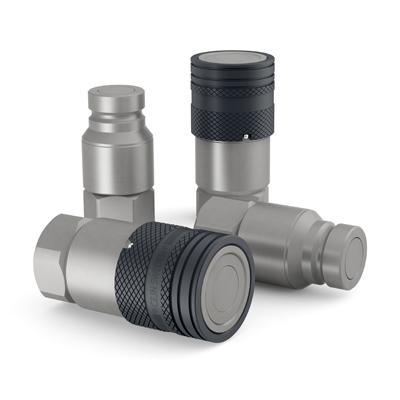
Series-X65-CEJN--lg
CEJN’s X65 quick connect couplings and nipples feature an extra security locking offers added protection against involuntary disconnection.

These safety devices feature a male end—or plug—that is inserted into a female end—or socket—to make a secure, leak-tight seal.

In extremely high-pressure hydraulic applications, a leak or accidental disconnection can cause serious personal injury or damage to machinery. In pneumatic applications, compressed air presents great dangers for hose whip.

They usually feature a one-way sleeve to allow for break-away with a tool when a coupling is clamp mounted. Two-way sleeves allow for one-hand disconnection. In two-way designs, twisting and pulling the two ends breaks the connection.

One of the most common designs is the flat face design, which is available as push-to-connect, threaded or screw-in. They eliminate any cavities where fluid or air can rest, thus removing the chance for trapped pressure and leakage. Flat face couplings provide high flow and low pressure drop and their sleeve-locking feature reduces the chance of accidental connection, removing leakage and spillage risks.

Ball or bearing types feature spring-loaded balls lodged in cavities to make the connection. They can be disconnected with just one hand.
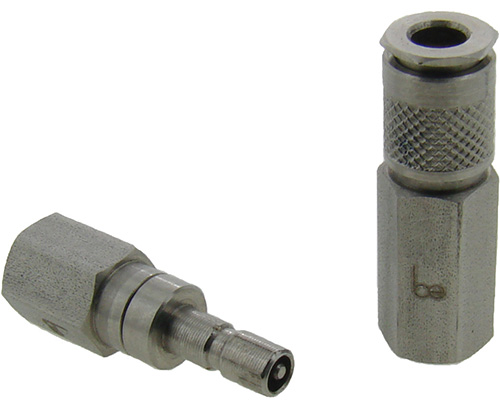
Beswick QDM3I-&-QDM3E_Ver.2_0G FEATURED quick couplings
Miniature quick-disconnects from Beswick Engineering. These dry-break designs are non-spill couplings.

For aggressive media, one should use non-spill designs. Non-latching couplings are heavily used in medical and test applications where frequent change-outs are common. Bayonet couplings feature two plugs that are engaged and locked by completing a quarter-turn to push the male end into the female socket. Disengaging and separation is the same, but in the opposite direction.

Keep safe design in mind
Remember: When selecting a hose coupling assembly, the lowest rated component is the actual safety factor. So if you have a 5,000 psi-rated hose but a 4,000 psi coupling, the safety factor of the assembly is 4,000 psi.

When working with aggressive media, using color-coded or key locks helps avoid cross connection. Ensure sealing materials and all internal materials are compatible with the fluids being used. And if available, check alert rings to ensure a system is properly connected; for example, some manufacturers use a red alert ring that disappears when a system is properly connected.

The dangers of oil injection injuries are real with high-pressure hydraulics. This is why hydraulic high-pressure quick couplings require more than just a Teflon tape seal or thread sealant. The higher pressure you are using, the stronger the seal required—ranging from rubber metal seals and copper seals to fully metal seals.
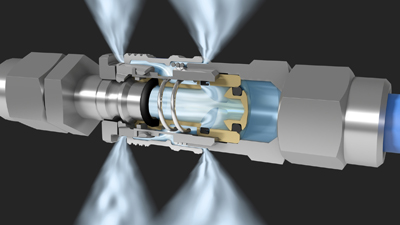
eSafe quick couplings
During disconnection, CEJN’s eSafe vents the down steaming pressure, eliminating recoil and reducing noise level.

Ensuring a safe end of life with quick couplings is also critical. When a coupling fails, you don’t want it to explode and have locking balls flying out. The design should fail with predetermined leakage paths so fluid comes out slowly.

To avoid unplanned failure, conduct regular inspections and maintenance to check for wear and damage. Ensure there is no brinelling occurring where the locking ball is. Also, a hose could fail before the coupling so a visual inspection for abrasion and cuts is necessary.

In pneumatic applications, safety couplings—such as CEJN’s eSafe—are designed to vent compressed air when the sleeve is pulled back while holding the nipple and hose assembly in place. After all the air is vented out of the system, only then does it release the hose, which prevents hose whip, popping noises and even moisture from escaping the system.

Filed Under: Couplings, Featured, Hose Assembly Blog, Hydraulic, Pneumatic, Quick-acting Tagged With: CEJN

Reader Interactions

Leave a Reply Cancel reply

Your email address will not be published. Required fields are marked *

This site uses Akismet to reduce spam. Learn how your comment data is processed.

Primary Sidebar

Fluid Power World Digital Edition

Fluid Power World Digital Edition

Browse the most current issue of Fluid Power World and back issues in an easy to use high quality format. Bookmark, share and interact with the leading design engineering magazine today.

Fluid Power Design Guides

fluid
“hat
EXPAND YOUR KNOWLEDGE AND STAY CONNECTED
Get the latest info on technologies, tools and strategies for Fluid Power Professionals.

Today on Hose Assembly Tips

Hannay Reels to display hose and cable reels at CONEXPO 2026

Hannay Reels will showcase custom hose and cable reel solutions for construction applications at CONEXPO 2026 in Las Vegas. Hannay Reels products … [Read More...] about Hannay Reels to display hose and cable reels at CONEXPO 2026

A designer’s guide to hose assemblies

By Josh Cosford, Contributing Editor Like their fitting and adapter brethren, hydraulic hose assemblies are often an afterthought to the hydraulic … [Read More...] about A designer’s guide to hose assemblies

Alkon introduces DuraLink DOT tubing for use with its push-to-connect fittings

Alkon Corp. introduced its new DuraLink DOT tubing, which now pairs with Alkon’s DOT push-to-connect fittings to deliver exceptional durability, … [Read More...] about Alkon introduces DuraLink DOT tubing for use with its push-to-connect fittings

How to stop hose expansion in its tracks

By Josh Cosford, Contributing Editor I’ll bet you didn’t even know hose expansion was a thing, did you? Sure, we know that hydraulic hose is made … [Read More...] about How to stop hose expansion in its tracks

Danfoss acquires Hydro Holding to expand European fittings footprint

Danfoss Power Solutions said it has completed its acquisition of hose fittings manufacturer Hydro Holding Spa after receiving the required approvals. … [Read More...] about Danfoss acquires Hydro Holding to expand European fittings footprint

A designer’s guide to fittings and adapters

By Josh Cosford,  Contributing Editor The hydraulic designer most frequently creates a hydraulic schematic to represent the entirety of the hydraulic … [Read More...] about A designer’s guide to fittings and adapters

Aeroquip by Danfoss hydraulic hose offers flexibility, lower weight to tractors

Danfoss Power Solutions launched its Aeroquip by Danfoss GH888 Main Pump Hose at Agritechnica this week, a two-wire braided hydraulic hose designed … [Read More...] about Aeroquip by Danfoss hydraulic hose offers flexibility, lower weight to tractors

Editorial Director Paul Heney

Paul Heney

Paul J. Heney, the Editorial Director for Design World, has a BS in Engineering Science & Mechanics and a minor in Technical Communications from Georgia Tech. Heney has more than 20+ years of experience in the fluid power industry, covering pneumatics, sensors, air preparation, pneumatic systems, valves and the whole spectrum of fluid power technology.

Subscribe

Fluid Power World Digital Edition

Fluid Power World Digital Edition

Browse the most current issue of Fluid Power World and back issues in an easy to use high quality format. Bookmark, share and interact with the leading design engineering magazine today.

Footer

Hose Assembly Tips

FLUID POWER WORLD NETWORK

  • Fluid Power World
  • Mobile Hydraulic Tips
  • Pneumatic Tips
  • Sealing and Contamination Tips
  • Fluid Power Distributor Lookup

HOSE ASSEMBLY TIPS

  • Subscribe to our newsletter
  • Advertise with us
  • About us

Copyright © 2026 · WTWH Media LLC and its licensors. All rights reserved.
The material on this site may not be reproduced, distributed, transmitted, cached or otherwise used, except with the prior written permission of WTWH Media.

Privacy Policy