
• Skip to primary navigation
  • Skip to main content
  • Skip to primary sidebar
  • Skip to footer
  • Advertise
  • Subscribe

Hose Assembly Tips

Fluid Power Resources for Hose and Hose Assemblies

  • Hose Assembly Blog
  • Industry News
  • Hydraulic hose
    • Rubber
    • Thermoplastic
  • Pneumatic tubing
  • Fittings
    • Hydraulic
    • Pneumatic
  • Couplings
    • Hydraulic
    • Pneumatic
    • Quick-acting
  • Design Guides

What is nonconductive hose?

February 1, 2017 By Ken Korane Leave a Comment

Engineers and technicians specifying hoses for hydraulic circuits routinely consider factors like pressure ratings and flow capacity. But in some instances, electrical shock is a potential risk to equipment and operators, and that demands hydraulic hoses that ensure safety when machines operate near high-voltage sources like power lines.

Thus, nonconductive hydraulic hoses are recommended for use in mobile-lift equipment like “cherry pickers,” hydraulic aerial-lift platforms, and agricultural and construction machinery. Nonconductive hoses are also routinely used in steel mills, foundries, mines and shipyards, and in rescue tools.

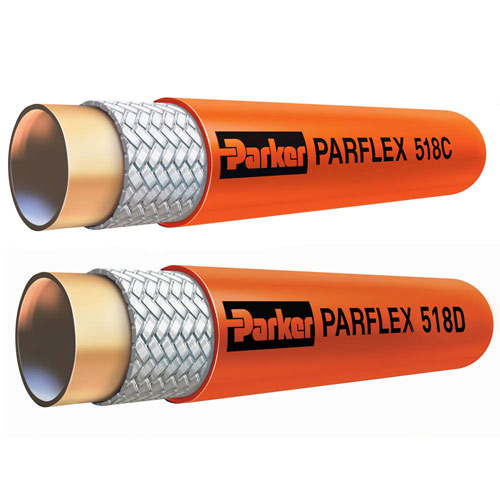
Parker-non-conductive-safe-hose-designs-518D_zm
Image courtesy of Parker Hannifin

Users should never assume a hose is electrically nonconductive, especially if it is made of rubber. That’s because rubber compounds can vary widely in their electrical-conductivity characteristics and, therefore, can be electrically conductive, partially conductive or non-conductive. Further, some rubber hoses can be non-conductive at low voltages but conductive at high voltages. Add to that, they often have steel wires for reinforcement. And unless designed and manufactured for specific electrical characteristics, a hose’s electrical properties may change from one production run to the next.

Nonconductive hose, on the other hand, is specifically built and tested to ensure the proper electrical properties. For example, the SAE J517 standard for 100R7 and 100R8 hoses states that permissible conductivity should be less than 50 micro-amps leakage under 75,000 volts per foot of length. Such hose is, for example, built with a nylon or polyester inner tube, one or two layers of braided textile or synthetic fiber reinforcement, and cover materials like polyurethane or PVC. These typically run in sizes from 3/16 to 1 in. ID and have maximum operating pressures from around 1,000 to 5,000 psi. And they often feature an orange or other non-black cover. Some versions with multiple layers of high-tensile, aramid-fiber reinforcement can have maximum pressure ratings of 10,000 psi or higher.

Many reputable manufacturers offer 100R7, 100R8 and other nonconductive hoses to transport petroleum-based, water-based, and synthetic hydraulic fluids without a risk of conducting electricity. And they routinely engineer-in other performance characteristics like a tight minimum bend radius, excellent kink resistance, abrasion resistance and suitability for operation in temperatures from about –40° to 212° F (-40° to 100° C).

As a final note of caution: For general hydraulic systems that may contact high-voltage sources, unless a hose is specifically and clearly branded electrically nonconductive, engineers, maintenance technicians and users alike must assume that it is not.

Filed Under: Featured, Hose Assembly Blog, Hydraulic hose

Reader Interactions

Leave a Reply Cancel reply

Your email address will not be published. Required fields are marked *

This site uses Akismet to reduce spam. Learn how your comment data is processed.

Primary Sidebar

Fluid Power World Digital Edition

Fluid Power World Digital Edition

Browse the most current issue of Fluid Power World and back issues in an easy to use high quality format. Bookmark, share and interact with the leading design engineering magazine today.

Fluid Power Design Guides

fluid
“hat
EXPAND YOUR KNOWLEDGE AND STAY CONNECTED
Get the latest info on technologies, tools and strategies for Fluid Power Professionals.

Today on Hose Assembly Tips

A designer’s guide to hose assemblies

By Josh Cosford, Contributing Editor Like their fitting and adapter brethren, hydraulic hose assemblies are often an afterthought to the hydraulic … [Read More...] about A designer’s guide to hose assemblies

Alkon introduces DuraLink DOT tubing for use with its push-to-connect fittings

Alkon Corp. introduced its new DuraLink DOT tubing, which now pairs with Alkon’s DOT push-to-connect fittings to deliver exceptional durability, … [Read More...] about Alkon introduces DuraLink DOT tubing for use with its push-to-connect fittings

How to stop hose expansion in its tracks

By Josh Cosford, Contributing Editor I’ll bet you didn’t even know hose expansion was a thing, did you? Sure, we know that hydraulic hose is made … [Read More...] about How to stop hose expansion in its tracks

Danfoss acquires Hydro Holding to expand European fittings footprint

Danfoss Power Solutions said it has completed its acquisition of hose fittings manufacturer Hydro Holding Spa after receiving the required approvals. … [Read More...] about Danfoss acquires Hydro Holding to expand European fittings footprint

A designer’s guide to fittings and adapters

By Josh Cosford,  Contributing Editor The hydraulic designer most frequently creates a hydraulic schematic to represent the entirety of the hydraulic … [Read More...] about A designer’s guide to fittings and adapters

Aeroquip by Danfoss hydraulic hose offers flexibility, lower weight to tractors

Danfoss Power Solutions launched its Aeroquip by Danfoss GH888 Main Pump Hose at Agritechnica this week, a two-wire braided hydraulic hose designed … [Read More...] about Aeroquip by Danfoss hydraulic hose offers flexibility, lower weight to tractors

Lightweight air and multipurpose Vantage hose is designed for everyday use

Continental’s group sector ContiTech announced the launch of its new Continental Vantage hose product line engineered to provide dependable … [Read More...] about Lightweight air and multipurpose Vantage hose is designed for everyday use

Editorial Director Paul Heney

Paul Heney

Paul J. Heney, the Editorial Director for Design World, has a BS in Engineering Science & Mechanics and a minor in Technical Communications from Georgia Tech. Heney has more than 20+ years of experience in the fluid power industry, covering pneumatics, sensors, air preparation, pneumatic systems, valves and the whole spectrum of fluid power technology.

Subscribe

Fluid Power World Digital Edition

Fluid Power World Digital Edition

Browse the most current issue of Fluid Power World and back issues in an easy to use high quality format. Bookmark, share and interact with the leading design engineering magazine today.

Footer

Hose Assembly Tips

FLUID POWER WORLD NETWORK

  • Fluid Power World
  • Mobile Hydraulic Tips
  • Pneumatic Tips
  • Sealing and Contamination Tips
  • Fluid Power Distributor Lookup

HOSE ASSEMBLY TIPS

  • Subscribe to our newsletter
  • Advertise with us
  • About us

Copyright © 2026 · WTWH Media LLC and its licensors. All rights reserved.
The material on this site may not be reproduced, distributed, transmitted, cached or otherwise used, except with the prior written permission of WTWH Media.

Privacy Policy