
• Skip to primary navigation
  • Skip to main content
  • Skip to primary sidebar
  • Skip to footer
  • Advertise
  • Subscribe

Hose Assembly Tips

Fluid Power Resources for Hose and Hose Assemblies

  • Hose Assembly Blog
  • Industry News
  • Hydraulic hose
    • Rubber
    • Thermoplastic
  • Pneumatic tubing
  • Fittings
    • Hydraulic
    • Pneumatic
  • Couplings
    • Hydraulic
    • Pneumatic
    • Quick-acting
  • Design Guides

The lowdown on hydraulic hose

April 22, 2014 By Paul Heney Leave a Comment

By Josh Cosford

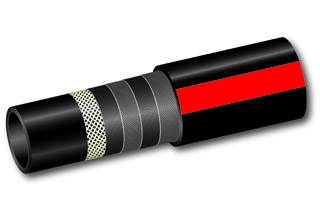
Generic Spiral hoseEarly hydraulic systems were installed on large machines, which meant they were stationary beasts—and as a result, their plumbing systems could be hard-piped. When someone discovered the usefulness of hydraulic actuators weren’t limited to stationary machines, the first hydraulic hoses had to be invented to allow motion between two points of movement, such as a boom.

Although hydraulic pressure could be contained within a cylinder with leather V-packing seals, a simple consideration of the units we use to describe pressure helps in understanding initial difficulties in manufacturing flexible conduits … pounds per square inch. A square inch is about the size of a very large postage stamp. Imagine stacking hundreds of pounds on that little square inch, and you can what engineers were up against; especially considering only natural materials for their solution were available a century ago. We take it for granted now, but imagine you stood barefoot on a tall Lego block and then pile a couple tons on your shoulders; that’s what hose has to withstand from the inside.

Spoiler alert! They worked it out. Early hydraulic hose was made from an inner carcass of natural rubber surrounded by textile or yarn windings for strength. They would add an additional weave of textile on top for abrasion resistance. Hose construction of this sort would remain in production for a surprisingly long time, and I still come across an occasional hose with a cloth outer carcass.
To be fair, early hydraulic systems didn’t run much pressure, and even 1000 psi was once difficult to achieve. As the requirement for higher pressure evolved—and the capabilities to construct components advanced—so, too, did the capabilities of hydraulic hose advance. The addition of steel wire to the outside of the rubber inner core provided a boost to pressure rating.

By “braiding” the steel wire in hydraulic hose, you add resistance to radial expansion, but allow flexibility in bending. To further strengthen a hydraulic hose and increase its pressure capacity, multiple layers of steel braiding was added. Each later was separated by an additional rubber layer to prevent metal-on-metal abrasion, and eventually hydraulic hose was nick-named after the number of steel braid layers, such as “two-wire hydraulic hose.”

As is typical for any industry, various forms of hose construction evolved, and some hoses would apply spiral wound hose of textile or steel, with multiple spirals being wound in opposite directions. Eventually, high-tensile strength steel would make its way into the market as well, further improving the pressure capacity of hydraulic hose.

One of the biggest leaps in hose technology was the integration of synthetic rubbers. Buna N, or Nitrile, is the most popular rubber used in hydraulic machinery, because of its stability over a wide temperature range, and also its compatibility with most hydraulic oils. With modern materials and construction, hydraulic hose is now both strong and reliable, capable of running up to 5000 psi or more for years. Hoses with four layers of wire braids are now common on hydraulic systems, especially those on large diameter running high pressure, such as excavators. Hose materials and construction techniques will continue to improve as pressure rises in hydraulic systems, and I suspect the use of synthetic materials will pave the way to progress.

 

Filed Under: Hose Assembly Blog, Hydraulic hose

Reader Interactions

Leave a Reply Cancel reply

Your email address will not be published. Required fields are marked *

This site uses Akismet to reduce spam. Learn how your comment data is processed.

Primary Sidebar

Fluid Power World Digital Edition

Fluid Power World Digital Edition

Browse the most current issue of Fluid Power World and back issues in an easy to use high quality format. Bookmark, share and interact with the leading design engineering magazine today.

Fluid Power Design Guides

fluid
“hat
EXPAND YOUR KNOWLEDGE AND STAY CONNECTED
Get the latest info on technologies, tools and strategies for Fluid Power Professionals.

Today on Hose Assembly Tips

A designer’s guide to hose assemblies

By Josh Cosford, Contributing Editor Like their fitting and adapter brethren, hydraulic hose assemblies are often an afterthought to the hydraulic … [Read More...] about A designer’s guide to hose assemblies

Alkon introduces DuraLink DOT tubing for use with its push-to-connect fittings

Alkon Corp. introduced its new DuraLink DOT tubing, which now pairs with Alkon’s DOT push-to-connect fittings to deliver exceptional durability, … [Read More...] about Alkon introduces DuraLink DOT tubing for use with its push-to-connect fittings

How to stop hose expansion in its tracks

By Josh Cosford, Contributing Editor I’ll bet you didn’t even know hose expansion was a thing, did you? Sure, we know that hydraulic hose is made … [Read More...] about How to stop hose expansion in its tracks

Danfoss acquires Hydro Holding to expand European fittings footprint

Danfoss Power Solutions said it has completed its acquisition of hose fittings manufacturer Hydro Holding Spa after receiving the required approvals. … [Read More...] about Danfoss acquires Hydro Holding to expand European fittings footprint

A designer’s guide to fittings and adapters

By Josh Cosford,  Contributing Editor The hydraulic designer most frequently creates a hydraulic schematic to represent the entirety of the hydraulic … [Read More...] about A designer’s guide to fittings and adapters

Aeroquip by Danfoss hydraulic hose offers flexibility, lower weight to tractors

Danfoss Power Solutions launched its Aeroquip by Danfoss GH888 Main Pump Hose at Agritechnica this week, a two-wire braided hydraulic hose designed … [Read More...] about Aeroquip by Danfoss hydraulic hose offers flexibility, lower weight to tractors

Lightweight air and multipurpose Vantage hose is designed for everyday use

Continental’s group sector ContiTech announced the launch of its new Continental Vantage hose product line engineered to provide dependable … [Read More...] about Lightweight air and multipurpose Vantage hose is designed for everyday use

Editorial Director Paul Heney

Paul Heney

Paul J. Heney, the Editorial Director for Design World, has a BS in Engineering Science & Mechanics and a minor in Technical Communications from Georgia Tech. Heney has more than 20+ years of experience in the fluid power industry, covering pneumatics, sensors, air preparation, pneumatic systems, valves and the whole spectrum of fluid power technology.

Subscribe

Fluid Power World Digital Edition

Fluid Power World Digital Edition

Browse the most current issue of Fluid Power World and back issues in an easy to use high quality format. Bookmark, share and interact with the leading design engineering magazine today.

Footer

Hose Assembly Tips

FLUID POWER WORLD NETWORK

  • Fluid Power World
  • Mobile Hydraulic Tips
  • Pneumatic Tips
  • Sealing and Contamination Tips
  • Fluid Power Distributor Lookup

HOSE ASSEMBLY TIPS

  • Subscribe to our newsletter
  • Advertise with us
  • About us

Copyright © 2026 · WTWH Media LLC and its licensors. All rights reserved.
The material on this site may not be reproduced, distributed, transmitted, cached or otherwise used, except with the prior written permission of WTWH Media.

Privacy Policy