
In the classic science-museum demonstration, a technician—wearing a white lab coat and safety goggles—dips a soft rubber ball into a container of liquid nitrogen and then flings the ball against a wall. Predictably, and to the delight of the audience, the now rock-hard ball shatters into a thousand pieces.
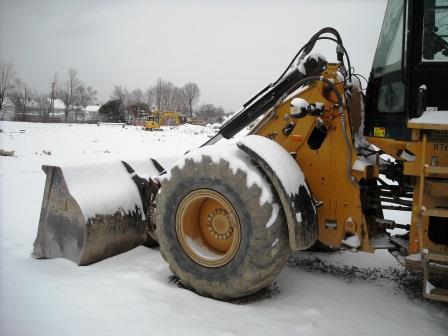
The same outcome isn’t so funny when using the wrong hydraulic hose in extreme cold.
That’s because elastomers that make up the cover and inner tube of rubber hose, when cooled to sufficiently low temperatures, no longer behave in a readily deformable manner. Instead they become hard, stiff and brittle.
Materials-engineering textbooks associate this with thermal changes that affect molecular behavior. At ambient temperatures, an elastomer’s polymer chains have sufficient energy to let them rotate and vibrate, and on a macro scale that gives the material flexibility. As temperatures drop, however, motion in the polymers slows. Eventually, this causes the elastomer to become tough and leathery.
With further cooling, the material reaches the glass transition temperature, Tg. Glass transition is a reversible change in an amorphous polymer where physical properties change from leathery to glasslike material. Tg is usually a narrow temperature range, rather than a sharp point like the freezing or boiling point of a substance.
An elastomer’s usefulness at low temperatures depends on whether it remains above its Tg. At or below the glass transition temperature, stress, strain and impact loads will damage and fracture the elastomer.
It is also important to note that elastomers, such as those in hydraulic hose, can degrade when subjected to thermal cycling. Although elastomers may operate within their stated minimum and maximum temperature limits, problems can crop up when elastomers are heavily plasticized or include additives that give low-temperature flexibility. In these cases, additives can leach out at elevated temperatures, which reduces performance capabilities on subsequent low-temperature excursions.
Hose manufacturers rely on cold-flexibility tests, using guidelines like ISO 10619, to design and rate their products. When tested, the sample’s tube or cover should not crack; and when warmed to ambient temperature, the test piece should not leak or crack when subjected to proof pressure.
In operation at very low temperatures, hose can exhibit fine radial cracks on the cover surface and the inner tube. Maintenance personnel should routinely inspect hoses operating under such conditions and immediately replace those with noticeable damage.
Rubber blends in typical hydraulic hose are rated for cold-weather operation to –40° F (–40° C). However, a number of hose manufactures offer a wide range of products suitable for lower temperatures. Here are a few examples:

Continental Arctic Series (http://contitech.us) hoses are rated to temperatures of –58° F (–50° C). They have Nitrile inner tubes, Neoprene covers and two-wire-braid construction with ID sizes from 0.25 to 1.25 in. Working pressure ranges from 1,820 to 5,800 psi, depending on the size.
Eaton Ice Champion (www.eaton.com/hydraulics) hose is rated for temperatures to –70° F (–57° C) at pressures to 6,100 psi. The four and six-spiral wire reinforced hose comes in ID sizes from 0.75 to 2 in.
Gates PolarFlex (www.gates.com) hose is rated for temperatures from –70° to 212° F (–57° to 100° C). The Global G2L version, for example, has two-braid steel wire reinforcement and meets 100R2 Type AT specs. It has a Nitrile tube and Neoprene cover.
Hansa-Flex HD (www.hansa-flex.com) high thermal resistance hose is for low and medium pressure circuits that run in extreme temperatures, with a rated temperature range of –67° to 275° F (–55° to 135° C). Tubes and covers are made of synthetic rubber. Sizes for the 100T Series range from 0.25 to 1 in. ID and working pressures are from 1,294 to 3,307 psi (88 to 225 bar), depending on size. 200T Series hoses come in ID sizes from 0.25 to 2 in. in pressures rated from 1,176 to 5,880 psi (80 to 400 bar).
Parker Hannifin LT Series (www.parker.com/hpd) hoses have working pressures up to 6,000 psi and sizes to 1.5-in. ID, depending on the version. They have a synthetic rubber inner tube and PKR or synthetic rubber cover. Minimum temperature rating is –70° F (–57° C).

Three of the five hoses listed do not have a maximum temperature stated. Most hoses are also subjected to very high temperatures from the host equipment and summer environments. Care to comment?
I had no idea that there were hose companies that made hoses specifically to withstand cold temperatures. My brother just moved to Alaska for some work and he was worried about the cold as much as anything else. I’ll have to pass this onto him so he knows where to look if he ever needs anything repaired. Thanks for sharing!
Also Dunlop Hiflex / Alfagomma has a low-temp hydraulic hose
http://lwbalsta.se/wp-content/uploads/2016/06/4afab113-79c6-4305-bfc9-09b21e46ce30-large.jpeg