
By: Eric Durrant, senior global product manager, Eaton
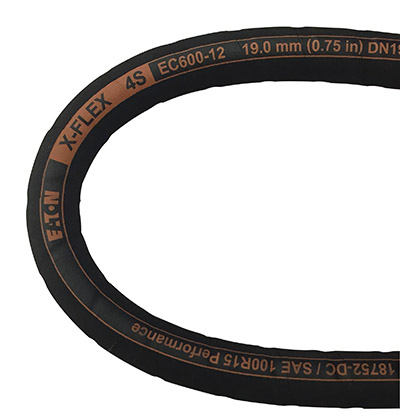 It’s happened on every job. A piece of machinery goes down, and operators need to get it back up and running to keep work moving. The hose assembly shop is closed or doesn’t have the right fitting in stock, so the team does whatever they need to get the machine up and running. Cost can be a factor too, with bulk fittings available online or from warehouses that claim to work with hoses. But these fittings usually don’t have the formal qualification testing to ensure that the connection is reliable and safe.
So owners and operators are forced to choose between spending more up front, some in cost and some in downtime, to get the right fitting to match the hose or saving up front and installing fittings that do not match the existing hose or assembly. It might seem like an obvious choice to take the savings and move on with the job, but there are benefits to investing up front in common hose and fittings.
- Manufacturer guarantees. Companies that make and sell hoses and fittings provide engineered systems with warranties that are backed by regular testing. If a hose assembly has been built and installed to the manufacturer’s specifications, companies usually offer protection if that assembly fails. Choosing bulk online fittings to match a manufacturer’s hose, though, usually voids that warranty and removes the protection.
- Industry specifications. The Society of Automotive Engineers’ (SAE) standards note in SAEJ1273, Section 6.3 that “Hose from one manufacturer is not usually compatible with fittings from another. Do not intermix hose and fittings from two manufacturers without approval from both manufacturers.” Two manufacturers might offer similar hose and fitting products, and they might seem close enough to work. But SAE guidance is clear on the topic. The International Standards Organization (ISO) and the European Standards (EN) also offer regulations on performance criteria and guidelines for hose performance.
- Rigorous testing. All hose assemblies offer performance guidelines, and many manufacturers run tests on hoses as they are manufactured and assembled. Manufacturers’ tests typically only demonstrate their hose product with their fitting product, and the hose and fitting interface is one of the most common areas of failure during testing, so matching is important.
Look for companies that proof-test every foot of hose that is sold, and have strict testing procedures, including: standard operating pressure; proof pressure, where a hose is held at two times the operating pressure for 30 sections; burst tests, when hoses are pressurized until failure, which should only take place at four times the stated operating pressure; and impulse life. Impulse testing is a very strenuous test where a hose assembly is pressurized on and off at approximately 60 cycles per minute at 135% to 150% of operating pressure. The test specifies the number of impulse cycles that need to be met to ensure the hose assembly is reliable.
- Risk. To determine if the cost is worth the risks, you must first understand the extent of the risk. When a hose assembly fails, hydraulic fluid is spewed everywhere. Depending on where the machine is operating, this can be a minor or major mess—but a mess either way. For example, if a hose assembly fails on a refuse truck collecting garbage on a city street, the owner of the truck will need to hire a company to clean up the spill and potentially face fines for spilling oil in the first place. The risk is different but no less important to consider indoors, where environmental fines may not as much of a concern, but danger to workers certainly is. Hydraulic fluid is very hot, and if a hose bursts it can cause severe burns.
The risk of downtime is also present. Hose failure will typically shut a piece of equipment down until the assembly can be repaired. When equipment is down, the dollars can quickly tick away—with lost productivity or even overtime to get the job done. The more frequently hose assemblies are failing, the more often your machine is down, the greater the risk to your bottom line. In the flurry of work to get the machine back up and running, there is also a risk of choosing the quickest or cheapest hose fitting, rather than the right one for the application. While this might be the easiest way to get the machine back online today, it increases the risk of the hose assembly failing again, bringing you right back to where you started.
- Assembling the hose. There is a lot of trial and error in finding the perfect hose assembly. Getting the crimp diameter to be perfect is a difficult task, and the tolerance on a crimp diameter is six thousandths of an inch. When buying a hose and fitting from one manufacturer, the company can advise the appropriate crimp diameter that will establish the best possible connection. Manufacturers like Eaton even measure the crimp diameter to one thousandth of an inch to improve the reliability of the connection. Buying a hose from one company and a fitting from another means there is no way of knowing the right connection, and estimating the connection can increase your risk for assembly failure.
No hose assembly will last forever, but choosing the right hose and fitting will help extend the life of the assembly – and keep your equipment and job up and running longer.
For more information, visit Eaton.com/hose.

[…] you will pay for it. If you do buy the machine and need to replace parts, make sure you buy the correct hose. Talk to your local dealer to find out […]